

















THE EVOLVED EDIT
Can You Bring a Power Bank on a Plane? Current Rules
Most ordinary power banks can fly in carry-on baggage. Learn how watt-hours, battery condition and airline policies determine what is allowed.
Power-bank flight rules in one minute
- Carry-on only: power banks are spare lithium batteries and are not permitted in checked baggage.
- 0–100Wh: allowed under the FAA framework without airline approval, subject to airline and route rules.
- 101–160Wh: airline approval is required and quantity is limited.
- More than 160Wh: spare batteries are not permitted on passenger aircraft under the FAA rule.
- Protect the battery: prevent short circuits, accidental activation and physical damage.
What are the FAA and TSA power-bank rules?
The FAA treats a power bank as a spare lithium battery because it is a battery intended to power another device. Spare lithium batteries must be carried in the aircraft cabin, where a problem can be noticed and addressed. TSA likewise lists power banks as carry-on items only.
| Battery rating | Carry-on baggage | Checked baggage |
|---|---|---|
| 0–100Wh | Allowed under the FAA framework; airline rules still apply | Not allowed |
| 101–160Wh | Airline approval required; up to two spare batteries | Not allowed |
| More than 160Wh | Not allowed as a spare battery on passenger aircraft | Not allowed |
The FAA notes that airlines may be more restrictive. Security officers and the operating airline make practical decisions at the airport, so a compliant capacity does not override a product-condition issue or a stricter carrier policy.
How do you calculate a power bank's watt-hours?
Look for Wh on the battery label first. If only milliamp-hours and nominal voltage are shown, use:
Wh = (mAh ÷ 1,000) × V
Examples at a 3.7V nominal cell rating:
- 5,000mAh: (5,000 ÷ 1,000) × 3.7 = 18.5Wh
- 10,000mAh: (10,000 ÷ 1,000) × 3.7 = 37Wh
- 20,000mAh: (20,000 ÷ 1,000) × 3.7 = 74Wh
- 30,000mAh: (30,000 ÷ 1,000) × 3.7 = 111Wh
Do not assume every power bank uses 3.7V. Use the voltage printed by its manufacturer. For example, a 20,000mAh pack rated at 3.85V is 77Wh rather than 74Wh.
Are 10,000mAh and 20,000mAh power banks allowed?
They are commonly below 100Wh, but the label is what matters. Two examples from the current Evolved range are:
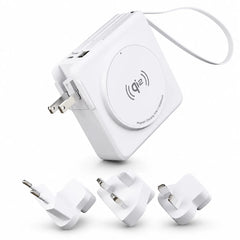
- MagBank Qi2 Universal 10K: listed as 10,000mAh at 3.7V, or 37Wh.
- MagBank Universal 65W 20K: listed as 20,000mAh at 3.85V, or 77Wh.
Both stated ratings fall below 100Wh, but they still belong in carry-on baggage. Confirm the label is readable and check the airline's current limits before leaving for the airport. If you are choosing between the two sizes, see our 10,000mAh vs 20,000mAh power-bank guide.
How to pack a power bank safely for a flight
- Put it in your carry-on. Do not place it in checked baggage. If a carry-on is gate-checked, remove all power banks first.
- Protect the terminals. Keep exposed contacts away from keys, coins and other metal objects. Use the original packaging, a protective pouch or another method that prevents a short circuit.
- Prevent accidental activation. Make sure buttons cannot be pressed continuously and built-in cables are secured.
- Keep the rating visible. Do not cover or remove the manufacturer's capacity and Wh label. A poorly labeled pack may be difficult to assess.
- Inspect it before packing. Do not travel with a swollen, cracked, leaking, recalled or unusually hot battery.
- Keep it accessible. Pack it where you can reach it if cabin crew ask to inspect it or if it begins to overheat.
- Follow crew instructions. Tell cabin crew immediately if a battery is hot, smoking, expanding, damaged or producing an odor.
Can you use or charge a power bank during the flight?
This depends on the airline. Some carriers prohibit using or charging power banks on board, even though an eligible power bank may be carried in the cabin. Others restrict where it can be stored so it remains visible and accessible.
Do not place an operating power bank where heat is trapped. Never charge it while it is inside a closed bag or seat pocket if the airline prohibits that storage. Follow cabin crew directions over any general online guide.
Why your airline's rule matters
The FAA sets a U.S. safety framework, but your journey may also be governed by the operating airline, airport security, departure authority, transit country and destination authority. A ticket sold by one airline may be operated by another, so check the carrier actually flying each segment.
Before departure:
- Search the operating airline's official site for “spare batteries” or “power banks.”
- Confirm its capacity, quantity, storage and in-flight-use rules.
- Check every connecting flight rather than only the first segment.
- Request written approval in advance for any battery from 101–160Wh.
- Recheck shortly before travel because policies can change.
What if your power bank is accidentally checked?
If airport staff take your carry-on at the gate or aircraft door, tell them you have a power bank and remove it before the bag enters the hold. If you discover it after the bag has been accepted, notify airline staff immediately. Do not assume a small power bank is exempt.
Can you bring multiple power banks?
The FAA does not set a universal numerical limit for ordinary spare batteries at or below 100Wh when they are for personal use, but airlines may set their own quantity limits. For 101–160Wh spare batteries, the FAA limit is two with airline approval.
Large quantities can raise questions about personal use. Bring only what you reasonably need and check the carrier's wording.
Choose a clearly labeled travel power bank
Compare Evolved power banks by Wh rating, capacity, output, size and weight. Airline eligibility is never a substitute for checking the product condition and your operating carrier's rules.
Frequently asked questions
Can I put a power bank in checked luggage?
No. Under FAA and TSA guidance, power banks are spare lithium batteries and must be in carry-on baggage.
Is a 20,000mAh power bank allowed on a plane?
Often, yes, when its printed rating is no more than 100Wh and it meets all other rules. Check the actual Wh label and airline policy; mAh alone is not enough.
Is a 30,000mAh power bank allowed?
It depends on voltage. At 3.7V, 30,000mAh equals 111Wh, which falls in the FAA's 101–160Wh category and requires airline approval. Use the product's printed values rather than an assumed voltage.
Do I need to take my power bank out at airport security?
Screening procedures vary by airport and instruction. Keep it accessible and follow the security officer's directions.
Can I fly with a damaged power bank?
No. Do not bring a swollen, cracked, leaking, recalled or otherwise damaged lithium battery. Isolate it safely and follow local battery-disposal guidance.
Are wireless power banks treated differently?
No. A magnetic or wireless power bank still contains a lithium battery and follows the same spare-battery rules.